

Best Volume Indicator For Forex
Book indicator analysis is an important technical parameter which is ignored by the traders especially the novice traders.
Volume plays an important function in technical analysis that helps in confirming trends and patterns.
It too indicates how many stocks were bought and sold in the market at a given menstruation. This helps u.s. in gauging how other traders are perceiving the market.
One of the main benefits of book is that information technology leads to cost motility of the stock i.e. giving us early signals when the cost movement is going to continue or reverse. Hence volume indicators are useful measures for a trader.
Before discussing the 9 Types of Volume Indicators let united states know what is the significance of high and low volume in the stock market:
Importance of High Volume:
Loftier volume indicates more interest in the stock and the presence of the buyers and sellers in that stock.
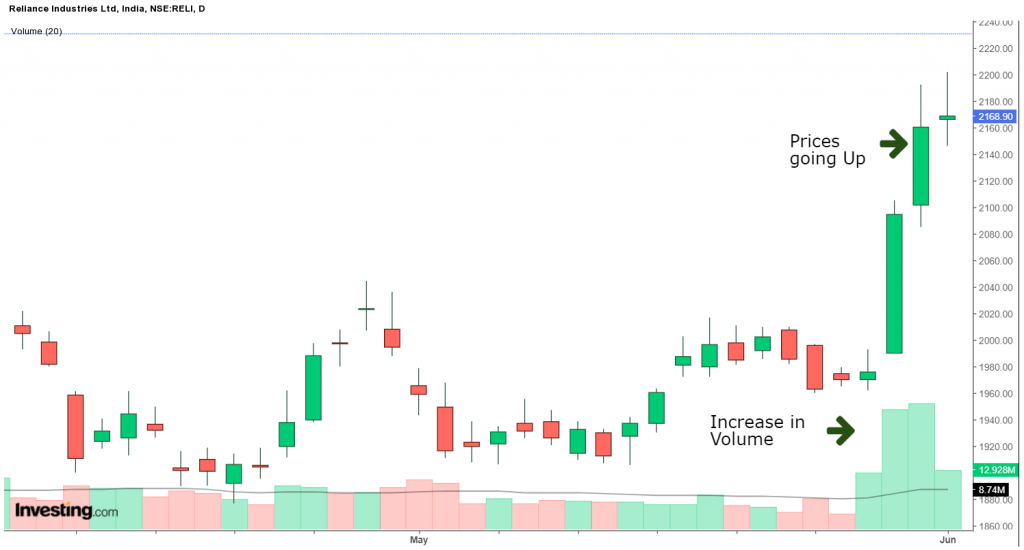
When the stock is in an uptrend and there is an increase in book along with the ongoing uptrend then the stocks will continue to get upwardly.
It indicates that more than and more than buyers are interested in buying that stock.
Similarly, when the stock is in the downtrend and there is an increase in volume along with the ongoing downtrend then the stocks will go on to go down.
As it indicates that more than and more than sellers are interested in selling that stock.
From the daily nautical chart of Reliance Ltd. We tin can see how increase in volume are leading the prices of the stock:
Importance of Depression Volume:
Low volume indicates lack of involvement in that particular stock.
When the stock is moving up and volume is falling then it indicates the interest of the buyers has reduced in the stock and the uptrend is going to contrary.
Similarly, when the stock is moving down and volume is falling and so it indicates the interest of the sellers take reduced in the stock and the downtrend is going to reverse.
Beneath is a tabular array which summarizes the above:
| Price | Book | What is Expected |
| Up | Upwards | Bullish |
| Up | Downwards | Caution- weak hands buying |
| Downward | Up | Bearish |
| Down | Down | Circumspection- weak hands selling |
Having understood the importance of loftier and low volume, now permit u.s.a. discuss nine Types of Volume Indicators that will assistance the traders to analyse volume in trading:
1. On-Rest indicator:
On Balance Book (OBV) is the volume indicator that calculates the ownership and selling force per unit area as a cumulative indicator which sums up volume on upward days and subtracts volume on down days.
When the stock closes college than the previous close, and then all of the day'southward volume is considered upwardly-volume.
Similarly when the stock closes lower than the previous close, then all of the day's volume is considered down-volume.
Rather than the value, ane should focus on its direction.
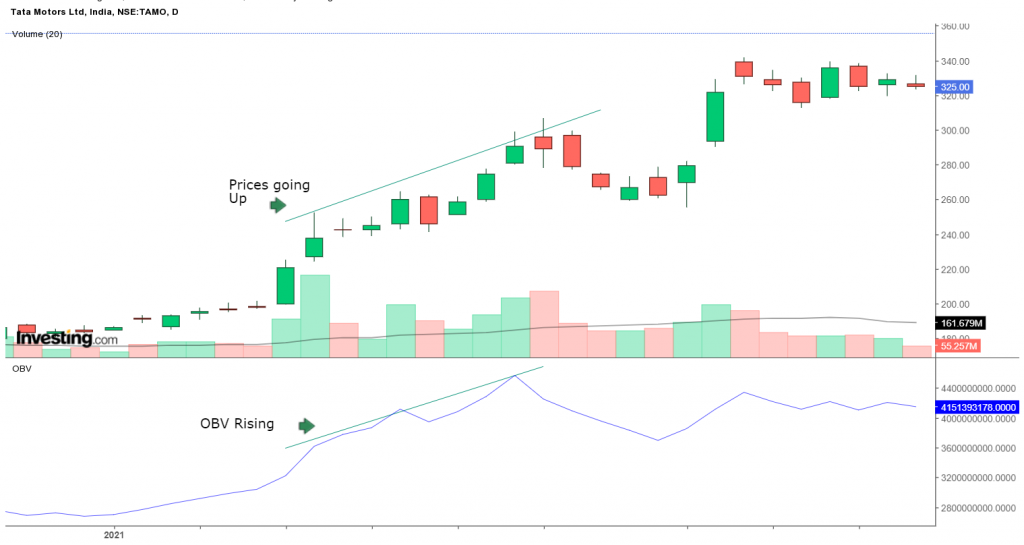
- When both toll likewise as OBV are making college peaks and higher troughs, then the upward trend is likely to continue as shown below:
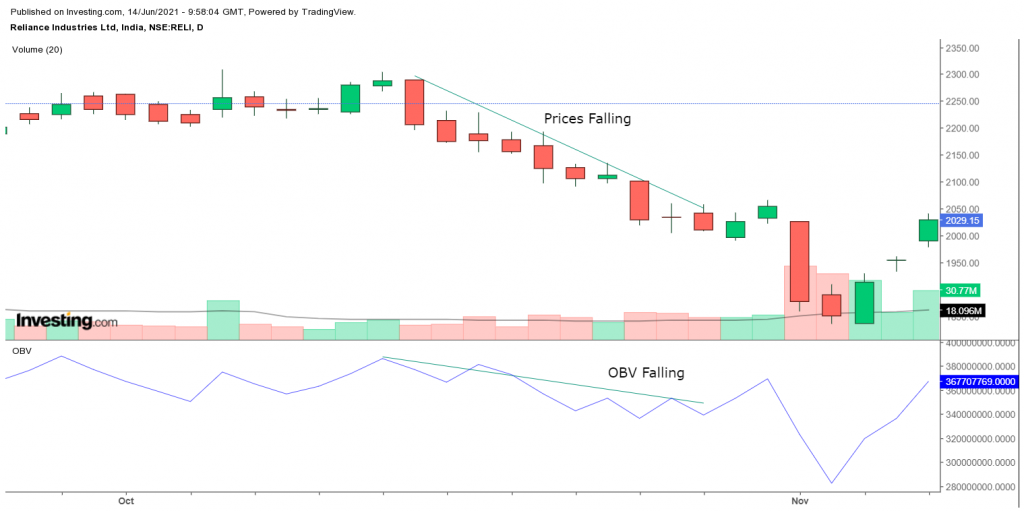
- When both cost as well as OBV are making lower peaks and lower troughs, so the downward trend is likely to go along equally shown beneath:
- When cost continues to make college peaks but OBV makes lower peaks, then the upward trend is probable to neglect, known as negative divergence.
- When cost continues to make lower troughs and OBV makes higher troughs, then the downward trend is to fail, known as positive divergence.
This indicator is calculated past adding the day'due south book to a cumulative total when the security's toll closes up, and subtracting the day's volume when the security'southward price closes down.
- If today's close is greater than yesterday'south close then: OBV = Yesterday's OBV + Today'due south Volume
- If today's close is less than yesterday's close then: OBV = Yesterday'south OBV – Today's Book
- If today'south shut is equal to yesterday's close and then: OBV = Yesterday'due south OBV
two. Volume RSI:
The Volume RSI (Relative Strength Index) is a book indicator which is like to the Relative Strength Index except that up-book and down-volume are used in the formula of RSI instead of changes in price.
Volume RSI oscillates around 50% center-line in the range from 0 to 100%.
I of the means of using this book indicator would be to trade on the signals generated on the crossovers of the indicator and 50% center-line effectually which information technology oscillates.
- When the Book RSI reading is above 50% then it is considered bullish indicating bullish volume dominates over bearish volume.
- When the Volume RSI reading is beneath 50% then it is considered as bearish indicating bearish volume dominates overbullish volume.
Thus, one should purchase when indicators movement above 50% line from below and sell when indicator drops beneath l% line from above as shown in the daily nautical chart of Bharat Heavy Electronics Ltd.

3. Book Price Trend Indicator:
The volume price trend (VPT) indicator is a volume indicator that helps in determining a stock'due south price management and also the strength of price change.
The indicator consists of a cumulative book line that adds or subtracts a multiple of the percentage modify in a share price'due south trend and electric current volume, that is based on the security'southward upward or downwardly movements.
This indicator is similar to the on-residuum book (OBV) indicator i.e. it measures cumulative volume and also provides traders with data nigh a security's money catamenia.
The interpretations of the VPT can be summed upwards as follows:
- An increase in price and volume confirms the price trend up.
- A decrease in price and volume confirms the price trend downwards.
- An increase in price accompanied by a decreasing or apartment volume trend is a negative difference suggesting that the downwardly cost motion is weak and may reverse.
- A decrease in price accompanied by an increasing or apartment volume trend is a positive divergence suggesting that the upwards price movement is weak and may reverse.
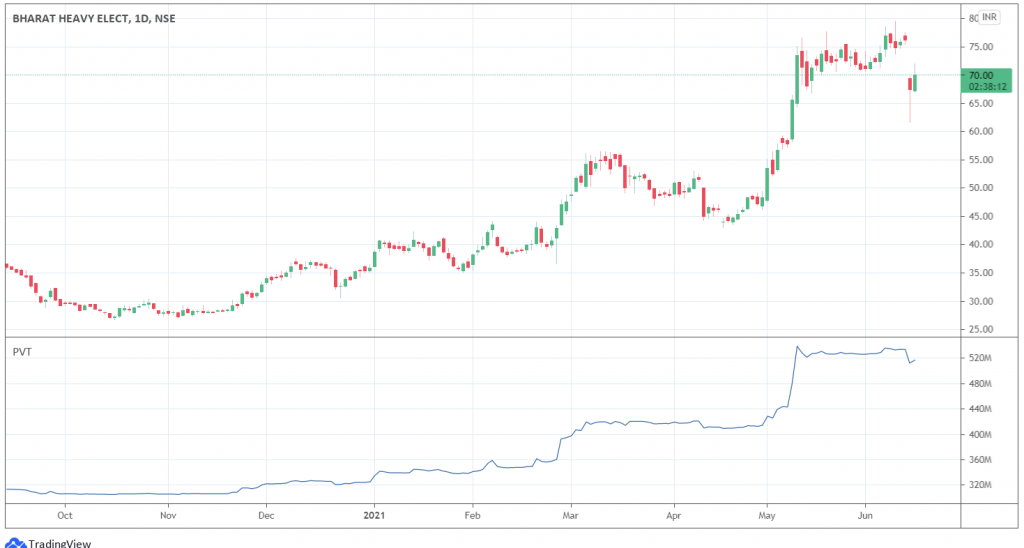
Below is daily chart of Bharat Heavy Electronics Ltd. which shows the VPT indicator:
4. Money flow index:
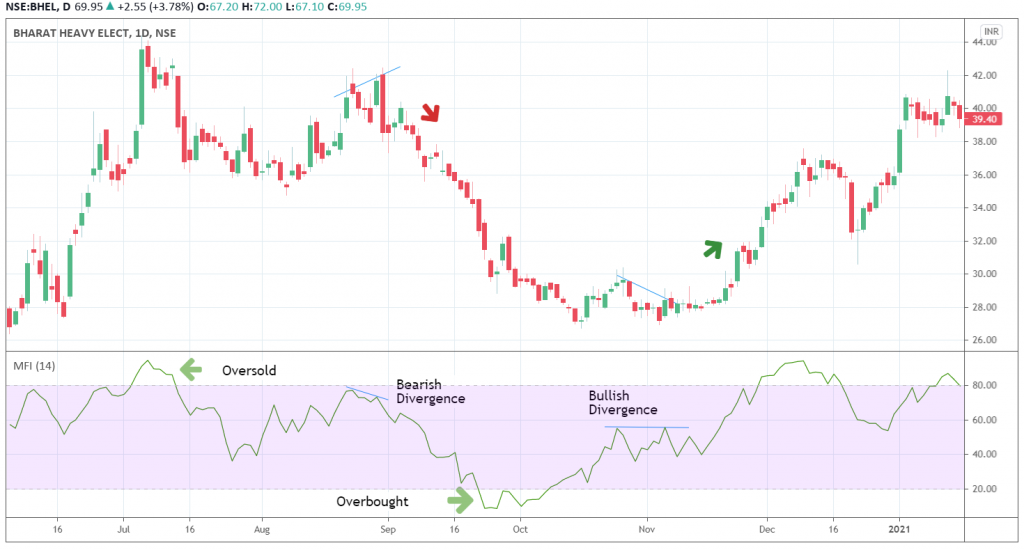
Money Catamenia Alphabetize (MFI) is a move as well as volume indicator which analyses both time besides as the price for measuring the trading pressure – ownership or selling.
It is besides known as volume-weighted Relative Strength Index (RSI), as it also includes volume, unlike RSI which only incorporates price.
Formula for calculating MFI:
Typical Price = (High + Low + Close)/3
Raw Coin Flow = Typical Cost x Volume
Money Period Ratio = (14-period Positive Money Flow)/(14-period Negative Money Flow)
Money Catamenia Index = 100 – 100/(i + Money Menstruum Ratio)
The Coin Menstruation Index (MFI) tin be interpreted virtually similarly to RSI. Trading signals are generated by this indicator when the stock signals bullish or bearish divergence, crossovers and when the stock is in the overbought or oversold zone as shown in the daily chart of Bharat Heavy Electronics Ltd.:
5. Chaikin Coin Period Indicator:
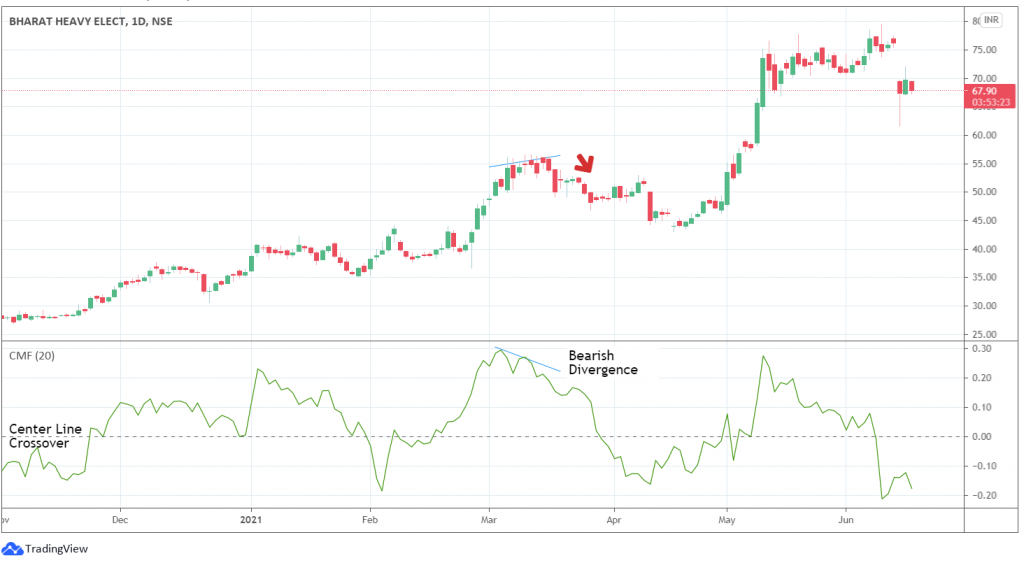
The Chaikin Coin Period indicator is a volume indicator that helps in measuring the amount of Money Catamenia Volume over a particular catamenia.
Chaikin Money Flow adds Coin Flow Volume for a particular look-back period, typically 20 or 21 days. This indicator fluctuates above/below the goose egg line similarly similar an oscillator.
According to this indicator, when the endmost price is near to the high so more than aggregating takes place. Similarly when the closing cost is about to the depression then more distribution takes place.
- A CMF value above the nothing line signals strength in the market whereas a value below the zero line signals weakness in the market.
- I should wait for the CMF to confirm the breakout management of price action, for example, if a price breaks upwardly through resistance, then ane should expect for the CMF to accept a positive value for confirming the breakout direction.
- A CMF sell point occurs when price makes higher high into overbought zones, with the CMF diverging with a lower high which is known as negative divergence.
- A CMF buy signal occurs when cost makes a lower depression with the CMF diverging with a college low with positive departure.
From the daily chart of Bhel Ltd, we can come across how subsequently brand surly divergences prices of the stock autumn downwards:
6. Accumulation/distribution:
The Accumulation Distribution Line is a book indicator which measures the cumulative flow of coin into and out of a stock.
A loftier positive multiplier with high volume indicates strong buying pressure which pushes the indicator college. On the other manus, a depression negative number with high volume indicates potent selling force per unit area which pushes the indicator lower.
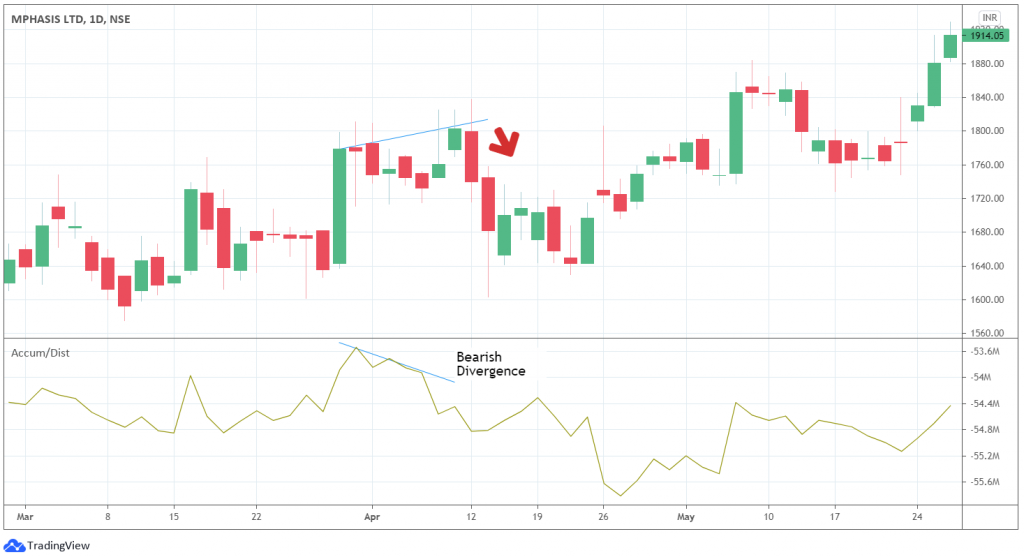
This indicator tries to detect positive or negative divergences in cost and volume data which signals an advanced alarm of future price movements.
From the daily chart of Mphasis Ltd, we can come across how after make bearish divergences prices of the stock fall down:
A trader who is accumulating stock is simply purchasing stock. As well, a trader who is sharing stock to the market is selling.
Thus, accumulation/distribution indicator size up need and supply, which drives price movement
7. Ease of movement:
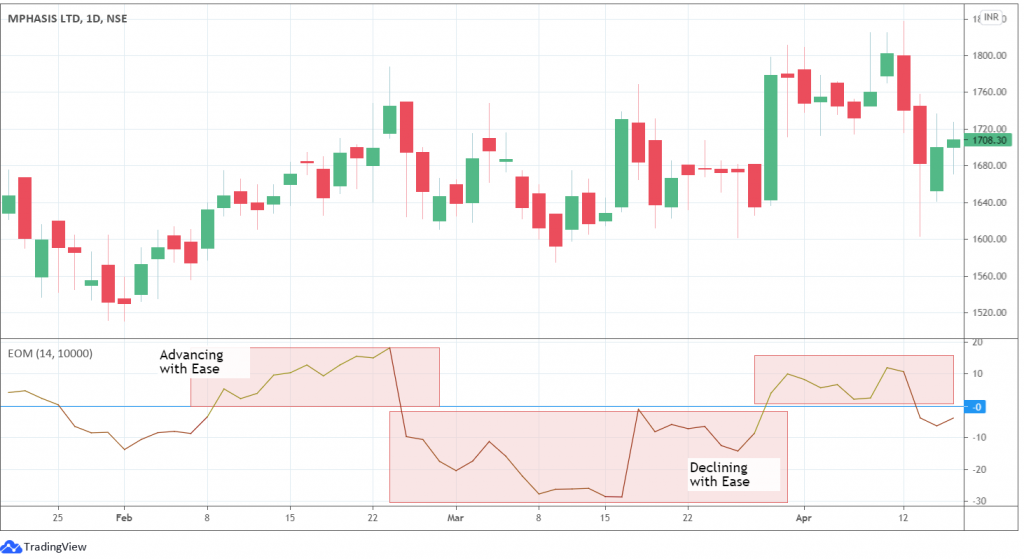
The Ease of Movement indicator some other important volume indicator, helps in measuring the 'ease' with which a stock price moves between different levels based on volume trends. An easy moving price is one which continues in its trend for a particular menstruum.
This indicator works all-time in volatile markets where the trends cannot exist clearly seen.
This indicator is all-time when it is used for longer fourth dimension frames, like a daily chart as it identifies trends based on volume averages.
This indicator generates purchase and sell signals when information technology crosses the 0 centreline or makes bearish or bullish divergences as shown in the chart below:
8. Negative volume index:
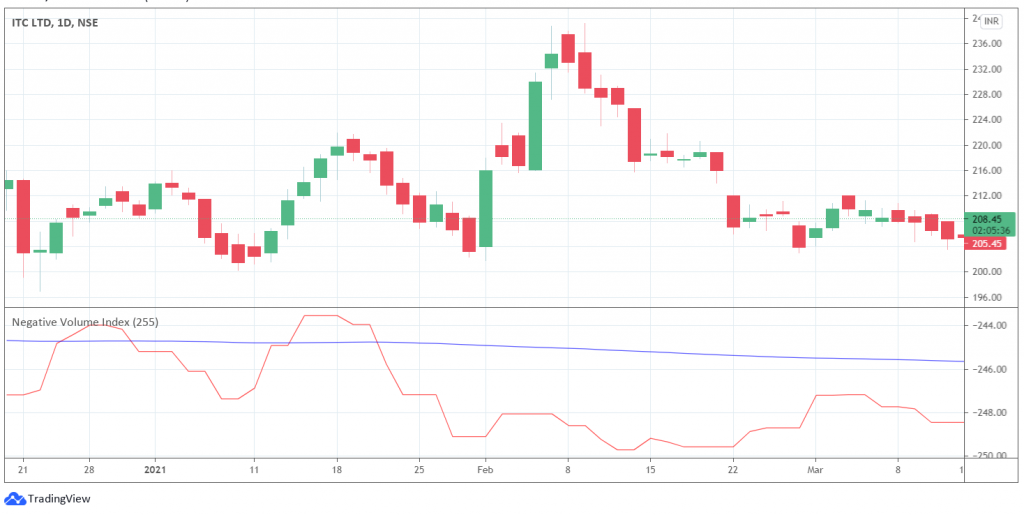
The Negative Volume Index (NVI) is a cumulative indicator which uses the change in volume for deciding when the smart money is agile.
This indicator works nether the assumption that the smart money is agile on days when volume decreases and the not-and so-smart money is active on days when volume increases.
According to this indicator a balderdash market is when NVI is above its 255-mean solar day EMA and the bear marketplace is when NVI is beneath.
nine. Book-weighted average toll:
The book-weighted average price shows the average price an asset has traded at throughout the trading session when both the toll equally well as volume are considered.
This indicator shows the actual value the security is trading at, so it can signal if the security was bought or sold at a fair cost.
Traders apply the VWAP for eliminating the noise in the market place to get an thought of what prices buyers and sellers are willing to transact.
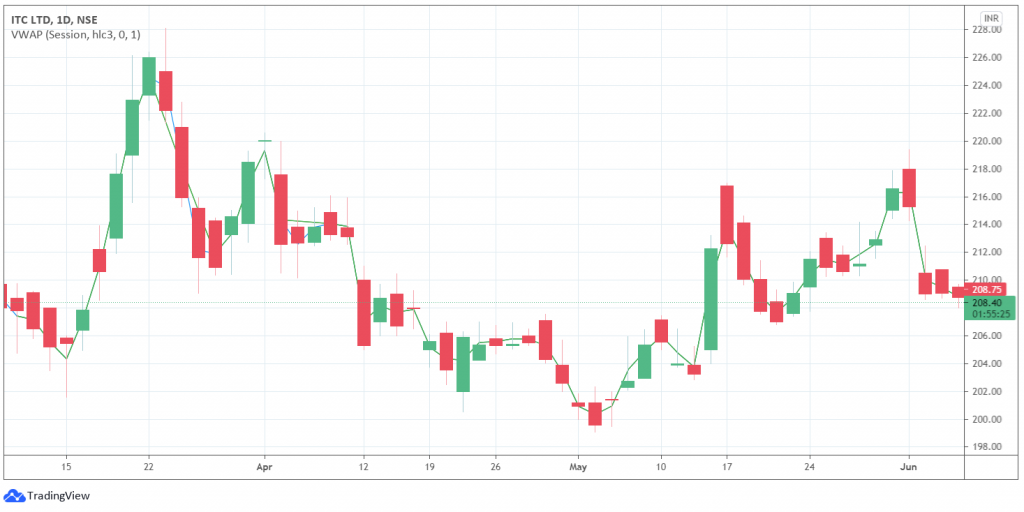
When the VWAP is rising or the price crosses above the VWAP line, so it shows that the prices are in an uptrend. Whereas if the VWAP is declining or the price crosses below the VWAP line, information technology shows that prices are in downtrend.
Watch the video below to know more than almost VWAP:
Bottomline:
As discussed, Book indicator analysis is a very important technical parameter to traders and investors. There are many volume indicators simply nosotros accept discussed some of the common and popular ones. Traders should study them and add them to your analysis tools for improving your trading.
Start volume analysis for free in StockEdge app.
Happy Investing!

Source: https://www.elearnmarkets.com/blog/volume-indicator/
Posted by: mccrorytheke1944.blogspot.com
0 Response to "Best Volume Indicator For Forex"
Post a Comment